|
|
1.1 State-Of-Charge (SOC) The state of charge can be defined as the state of available electrical energy in a battery, usually expressed as a percentage. Since the available power varies depending on the charge/discharge current, temperature and aging phenomenon, the definition of state of charge is also divided into two types: Absolute State-Of-Charge (ASOC) and Relative State-Of-Charge (RSOC). Usually the range of Relative State-Of-Charge is 0% - 100%, while the battery is 100% when fully charged and 0% when fully discharged. Absolute state-of-charge is a reference value that is calculated when the battery is manufactured and based on a fixed capacity value for which it was designed. A new fully charged battery has an absolute charge state of 100%; an aged battery, even if fully charged, will not reach 100% in different charge and discharge conditions. The graph below shows the relationship between voltage and battery capacity at different discharge rates. The higher the discharge rate, the lower the battery capacity. The battery capacity also decreases at lower temperatures. Figure 1: Relationship between voltage and capacity at different discharge rates and temperatures
1.2 Max Charging Voltage The maximum charging voltage is related to the chemical composition and characteristics of the battery. The charging voltage of Li-ion battery is usually 4.2V and 4.35V, while the voltage value may vary if the cathode and anode materials are different. 1.3 Fully Charged When the difference between the battery voltage and the maximum charge voltage is less than 100mV and the charge current is reduced to C/10, the battery can be considered fully charged. The fully charging conditions vary with different battery characteristics. The figure below shows a typical Li-ion battery charging characteristic curve. The battery is considered fully charged when the battery voltage is equal to the maximum charge voltage and the charge current is reduced to C/10.
1.4 Minimum Discharging Voltage (Mini Discharging Voltage) The minimum discharge voltage can be defined by the cutoff discharge voltage, which is usually the voltage at 0% of the charge state. This voltage value is not a fixed value, but varies with load, temperature, aging or other. 1.5 Fully Discharge When the battery voltage is less than or equal to the minimum discharge voltage, it can be called completely discharged. 1.6 Charge and discharge rate (C-Rate) The charge/discharge rate is an indication of the charge/discharge current relative to the battery capacity. For example, if 1C is used to discharge the battery for one hour, ideally the battery will be fully discharged. Different charge/discharge rates will result in different usable capacities. Usually, the higher the charge/discharge rate, the lower the available capacity. 1.7 Cycle life The number of cycles is the number of times a battery has undergone a complete charge and discharge, which can be estimated by the actual discharge capacity and the design capacity. Whenever the accumulated discharge capacity is equal to the design capacity, the cycle count is once. Usually after 500 charge/discharge cycles, the fully charged battery capacity will drop by 10% ~ 20%.
1.8 Self-Discharge The self-discharge of all batteries increases as the temperature rises. Self-discharge is basically not a manufacturing defect, but a characteristic of the battery itself. However, improper handling during the manufacturing process can also cause an increase in self-discharge. Usually, the self-discharge rate doubles with every 10°C increase in battery temperature. The self-discharge of lithium-ion batteries is about 1-2% per month, while the self-discharge of various types of nickel batteries is 10-15% per month.
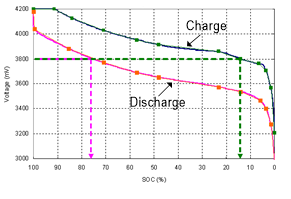
2.1 Power meter function introduction Battery management can be considered as a part of power management. In battery management, the power meter is responsible for estimating the battery capacity. Its basic function is to monitor the voltage, charge/discharge current and battery temperature, and to estimate the state of charge (SOC) and the fully charged capacity (FCC) of the battery. There are two typical methods to estimate the battery state of charge: the open circuit voltage (OCV) method and the coulometric method. Another method is the dynamic voltage algorithm designed by RICHTEK. 2.2 Open circuit voltage method The implementation of the power meter with the open-circuit voltage method is relatively easy, and can be obtained by checking the meter with the open-circuit voltage corresponding to the state of charge. The open-circuit voltage assumes the battery terminal voltage when the battery is rested for more than 30 minutes. The battery voltage curve will be different under different load, temperature, and battery aging conditions. Therefore, a fixed open-circuit voltmeter cannot fully represent the state of charge; you cannot rely on the meter alone to estimate the state of charge. In other words, if the state of charge is estimated only by checking the meter, the error will be very large. The graph below shows that the same battery voltage is charged and discharged respectively, and the charge state obtained by the open circuit voltage method varies greatly.
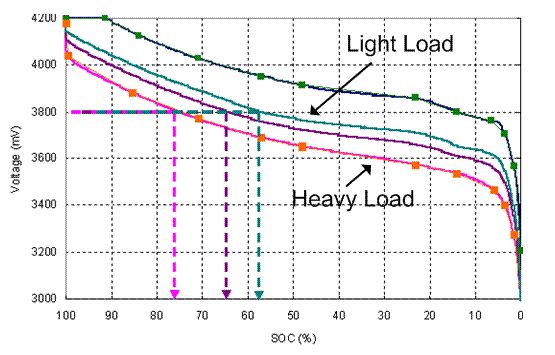
Figure V. Battery voltage under charging and discharging As you can see in the figure below, the charge state varies greatly under different loads during discharge. So basically, the open-circuit voltage method is only suitable for systems that require low accuracy of the charge state, such as lead-acid batteries for automobiles or uninterruptible power supplies.
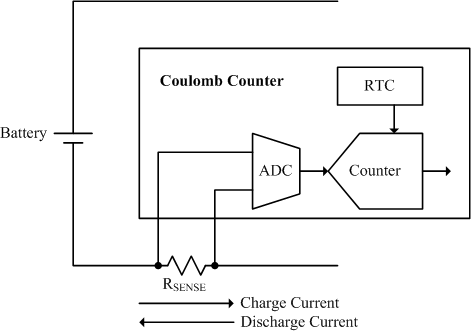
Figure 6: Battery voltage under different loads during discharge 2.3 Coulometric method Coulomb metering operates by connecting a sense resistor to the charge/discharge path of the battery, and the ADC measures the voltage across the sense resistor and converts it to the current value of the battery being charged or discharged. A real time counter (RTC) provides the integration of this current value over time to know how much coulomb has flowed.
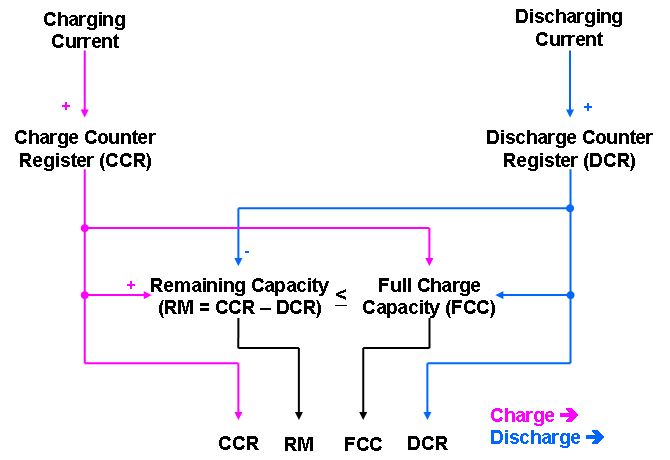
Figure 7. The basic way of working of Coulomb metrology Coulomb metering accurately calculates the charge state in real time during charging or discharging. It calculates the Remaining Charge Capacity (RM) and Full Charge Capacity (FCC) by means of a Charge Coulomb Counter and a Discharge Coulomb Counter. The remaining capacity (RM) and full charge capacity (FCC) can also be used to calculate the state of charge, i.e. (SOC = RM / FCC). In addition, it can also predict the remaining time, such as power depletion (TTE) and power full (TTF).
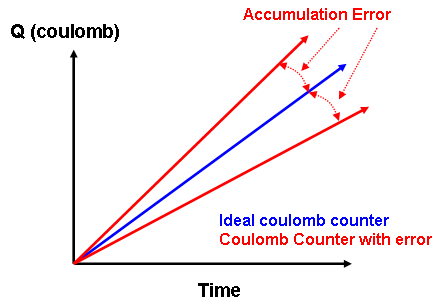
There are two main factors that cause deviations in the accuracy of Coulomb metrology. The first is the accumulation of offset error in current sensing and ADC measurements. Although this measurement error is quite small with current technology, it will increase with time if there is no good way to eliminate it. The figure below shows that in practical applications, if there is no correction for time duration, the accumulated error is uncapped.
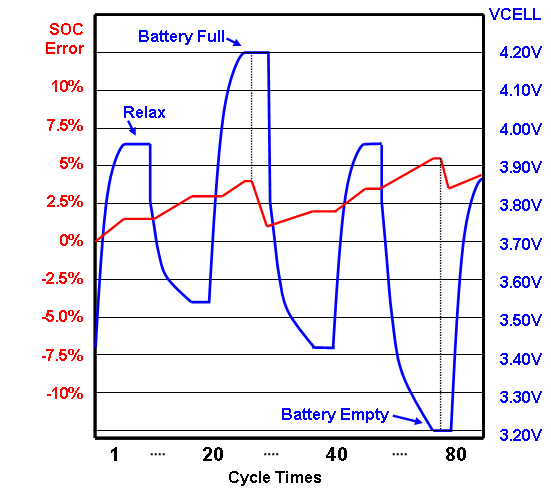
Figure 9. Cumulative error of Coulomb metrology To eliminate cumulative errors, there are three possible time points that may be used in normal battery operation: End of Charge (EOC), End of Discharge (EOD), and Rest (Relax). The end-of-charge condition is reached when the battery is fully charged and the state of charge (SOC) should be 100%. The end of discharge condition means the battery is fully discharged and the SOC should be 0%; it can be an absolute voltage value or vary with the load. When the rest state is reached, the battery is not charged nor discharged and remains in this state for a long time. If the user wants to use the battery rest state for the error correction of the coulometric method, then it must be combined with an open circuit voltmeter. The following diagram shows that the error of the charge state in the above state can be corrected.
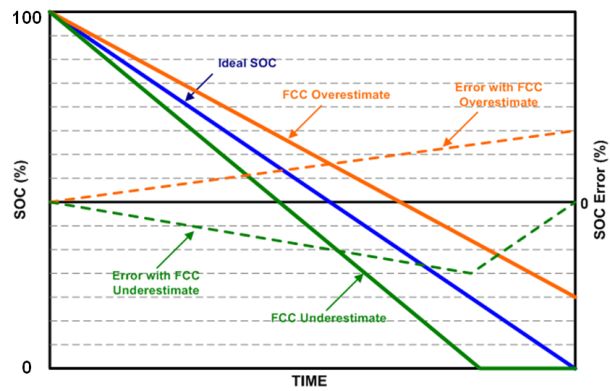
Figure X. Conditions for eliminating cumulative errors in coulometric methods The second major factor causing deviation in the accuracy of Coulomb metrology is the Full Charge Capacity (FCC) error, which is caused by the difference between the design capacity value of the battery and the true fully charged capacity of the battery. Full charge capacity (FCC) is affected by temperature, aging, load, etc. Therefore, the method of relearning and compensating the full charge capacity is very critical and important for coulometry. The following figure shows the trend phenomenon of charge state error when the full charge capacity is overestimated and underestimated.
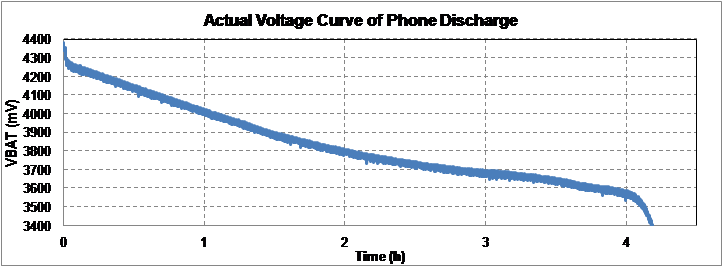
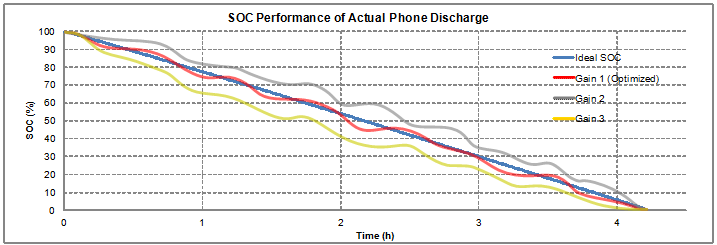
Figure 11. Trend of error when fully charged capacity is overestimated and underestimated 2.4 Dynamic voltage algorithm power meter The dynamic voltage algorithm power meter can calculate the charge state of a lithium battery based on the battery voltage alone. This method is based on the difference between the battery voltage and the open circuit voltage of the battery to estimate the incremental or decremental amount of the state of charge. The information of the dynamic voltage can effectively simulate the behavior of the Li-ion battery and thus determine the state of charge SOC (%), but this method does not estimate the battery capacity value (mAh). It calculates the charge state based on the dynamic difference between the battery voltage and the open-circuit voltage, lending to the use of an iterative algorithm to calculate each increase or decrease in the charge state to estimate the charge state. Compared to the coulometric solution, the dynamic voltage algorithm meter does not accumulate errors over time and current. Coulometric meters are usually inaccurate in estimating the state of charge due to current sensing errors and battery self-discharge. Even if the current sensing error is very small, the Coulomb counter will continue to accumulate error, and the accumulated error can only be eliminated when fully charged or fully discharged. The dynamic voltage algorithm meter estimates the state of charge of the battery from voltage information only; since it is not estimated from the current information of the battery, it does not accumulate errors. To improve the accuracy of the state of charge, the dynamic voltage algorithm needs to use an actual device to adjust the parameters of an optimized algorithm based on its actual battery voltage profile under fully charged and fully discharged conditions.
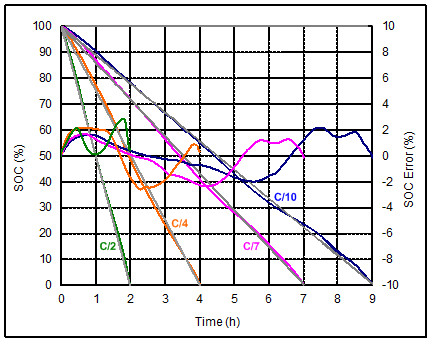
Figure 12, dynamic voltage algorithm power meter and gain optimization of the performance The following is the performance of the dynamic voltage algorithm for the charge state under different discharge rate conditions. As can be seen from the figure, it has a good accuracy of the charge state. Regardless of the discharge conditions such as C/2, C/4, C/7 and C/10, the overall charge state error of this method is less than 3%.
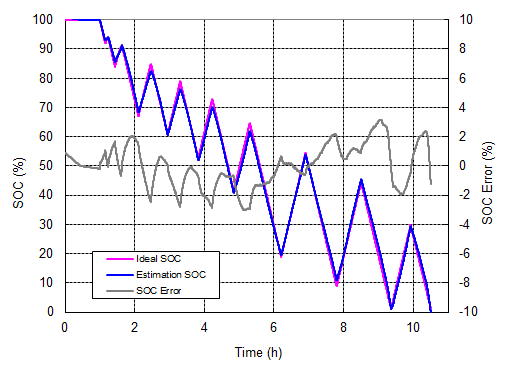
Figure 13: Representation of the charge state of the dynamic voltage algorithm under different discharge rate conditions The graph below shows the performance of the charge state under short charge and short discharge of the battery. The charge state error is still very small and the maximum error is only 3%.
Figure 14, in the case of short charge and short discharge of the battery, the performance of the charge state of the dynamic voltage algorithm Compared to coulometric meters, which usually have inaccurate charge states due to current sensing errors and battery self-discharge, dynamic voltage algorithms do not accumulate errors over time and current, which is a big advantage. Because there is no charge/discharge current information, the dynamic voltage algorithm is less accurate in the short term and has a slower response time. In addition, it cannot estimate the full charging capacity. However, it performs well in long-term accuracy because the battery voltage will eventually respond directly to its state of charge. Lastnews test 08Nextnews test 06 |
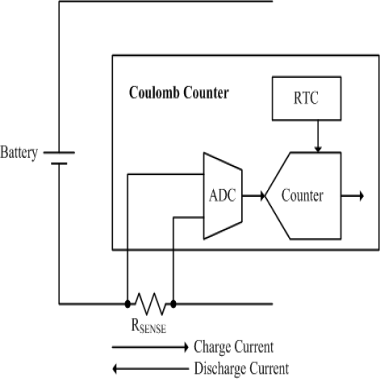
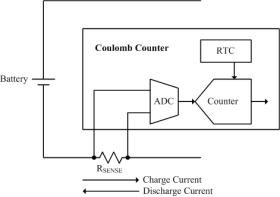
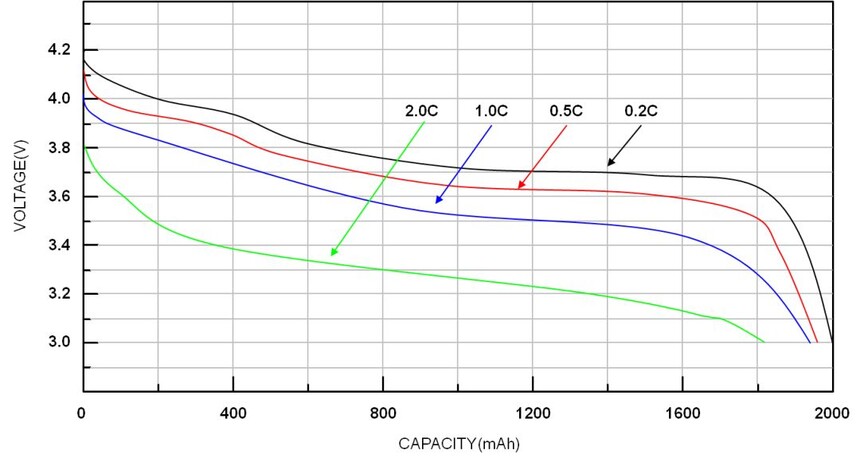
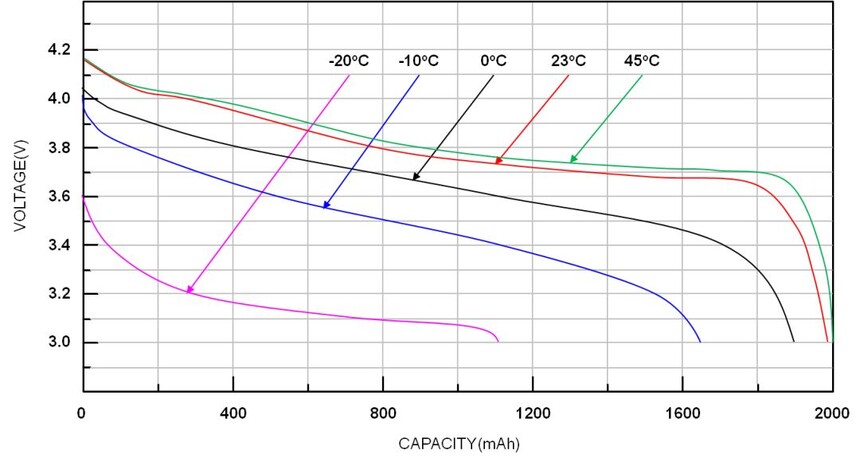
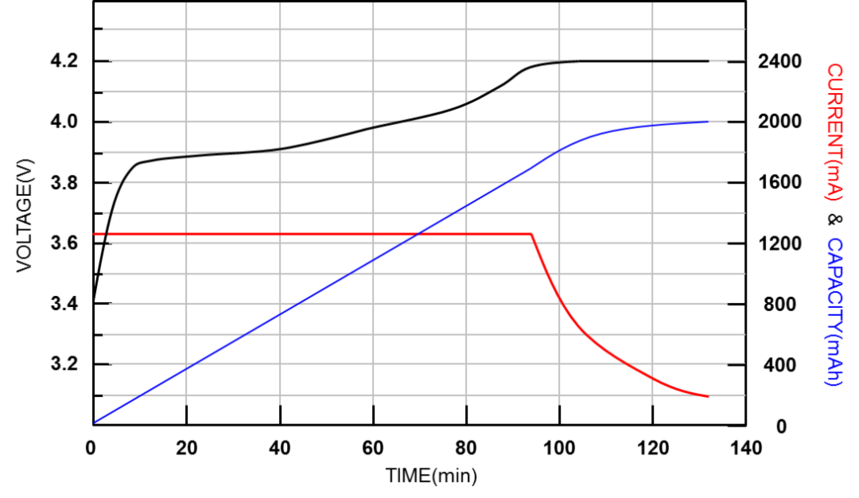 Figure 2: Li-ion battery charging characteristics curve
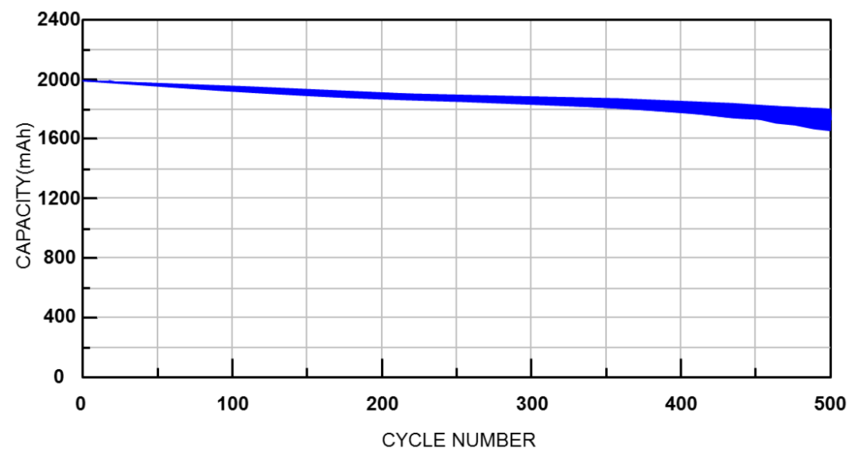 Figure 3, the relationship between the number of cycles and battery capacity
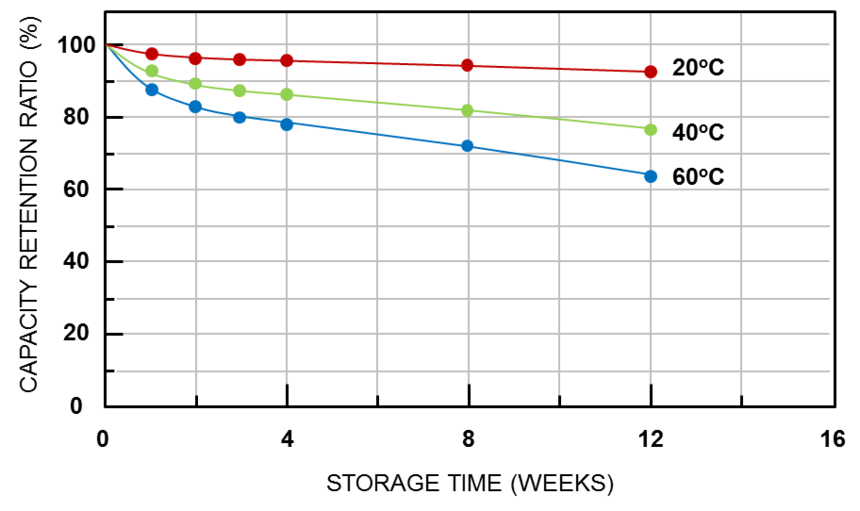 Figure 4: Self-discharge rate of lithium batteries at different temperatures